
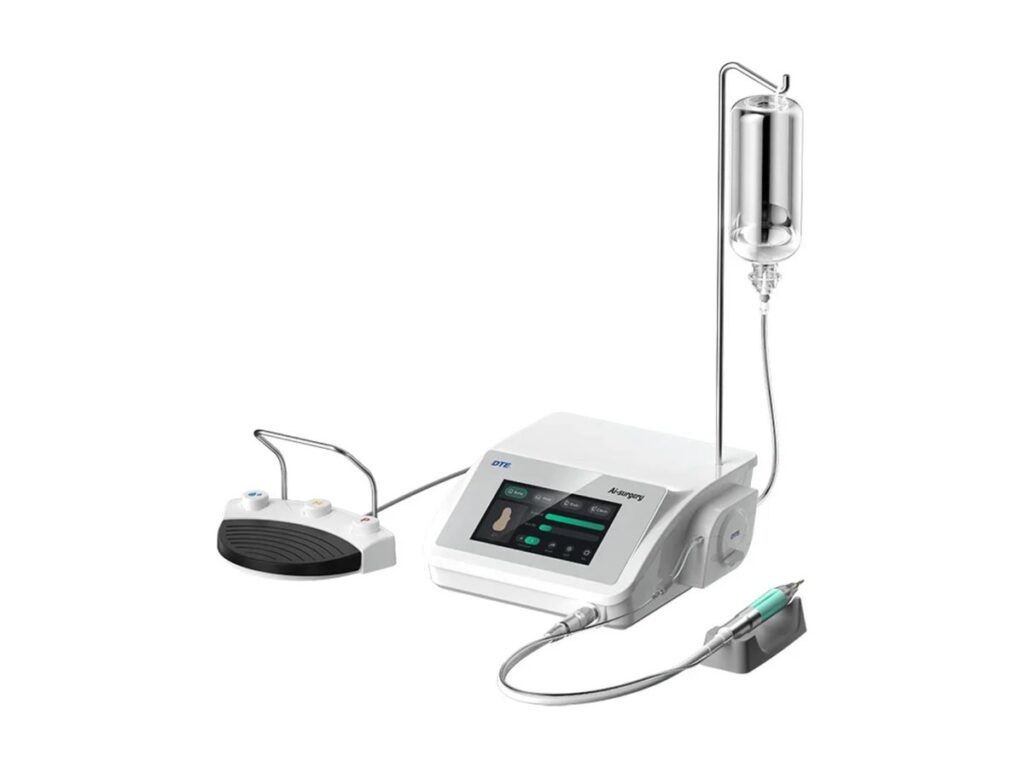
In wisdom tooth extraction, bone grafting, or sinus lifting, the doctor needs to cut or grind bone close to soft structures such as the sinus membrane, blood vessels, and nerves. High-speed rotary drills cut very quickly but can also damage soft tissue if they come into contact. The Ai-Surgery (DTE – Woodpecker, fourth generation) piezo ultrasonic surgical unit cuts bone using ultrasonic vibration, based on a different principle.
Selective cutting: bone is cut, soft tissue is preserved
The piezo cutting tip vibrates with a very small amplitude at ultrasonic frequencies, designed to act on mineralized tissue such as bone. Soft tissues like the sinus membrane, blood vessels, and nerves are much less affected when the cutting tip touches them lightly. Medical literature reviews note that the main advantages of piezo surgery are precise, selective cutting, avoidance of thermal damage, and preservation of soft tissue (Stübinger et al., 2015).
Less invasive
- Thin, precise cuts, removing less bone
- Continuous cooling water, limiting heat generation in the bone
- Clean surgical field, easy to observe
- Atraumatic tooth extraction: gently separate the tooth from the alveolar bone, preserve the bone wall, beneficial if an implant is placed later
Evidence in wisdom tooth extraction
A meta-analysis of 5 randomized controlled trials with 402 patients showed that, compared to conventional rotary instruments, the piezosurgery group experienced less pain on days 6–7, less swelling on day 7, and better mouth opening on the first postoperative day; in return, the surgical time was approximately 6 minutes longer (Liu et al., 2018). A recent systematic review also noted less pain and swelling; the rate of nerve injury in the piezo group was lower, although the difference was not statistically significant (Franco et al., 2024).
Applications at Lumière
- Atraumatic tooth extraction, preserving the alveolar bone before implant placement
- Extraction of difficult wisdom teeth, teeth located near the inferior alveolar nerve
- Sinus lift, helping to protect the sinus membrane
- Assisting in bone cutting, bone splitting, and bone grafting in dental implant procedures
Want to know if this technology is right for you? Book an appointment or see more about Technology & Sterilization at Lumière.
References
- Stübinger, S., Stricker, A., & Berg, B.-I. (2015). Piezosurgery in implant dentistry. Clinical, Cosmetic and Investigational Dentistry, 7, 115–124. https://doi.org/10.2147/CCIDE.S63466
- Liu, J., Hua, C., Pan, J., Han, B., & Tang, X. (2018). Piezosurgery vs conventional rotary instrument in the third molar surgery: A systematic review and meta-analysis of randomized controlled trials. Journal of Dental Sciences, 13(4), 342–349. https://doi.org/10.1016/j.jds.2016.09.006
- Franco, R., Di Girolamo, M., Franceschini, C., Rastelli, S., Capogreco, M., & D’Amario, M. (2024). The comparative efficacy of burs versus piezoelectric techniques in third molar surgery: A systematic review following the PRISMA guidelines. Medicina, 60(12), 2049. https://doi.org/10.3390/medicina60122049
Treatment results depend on each individual's oral health and general health. The dentist will advise on a suitable treatment plan after examination.