
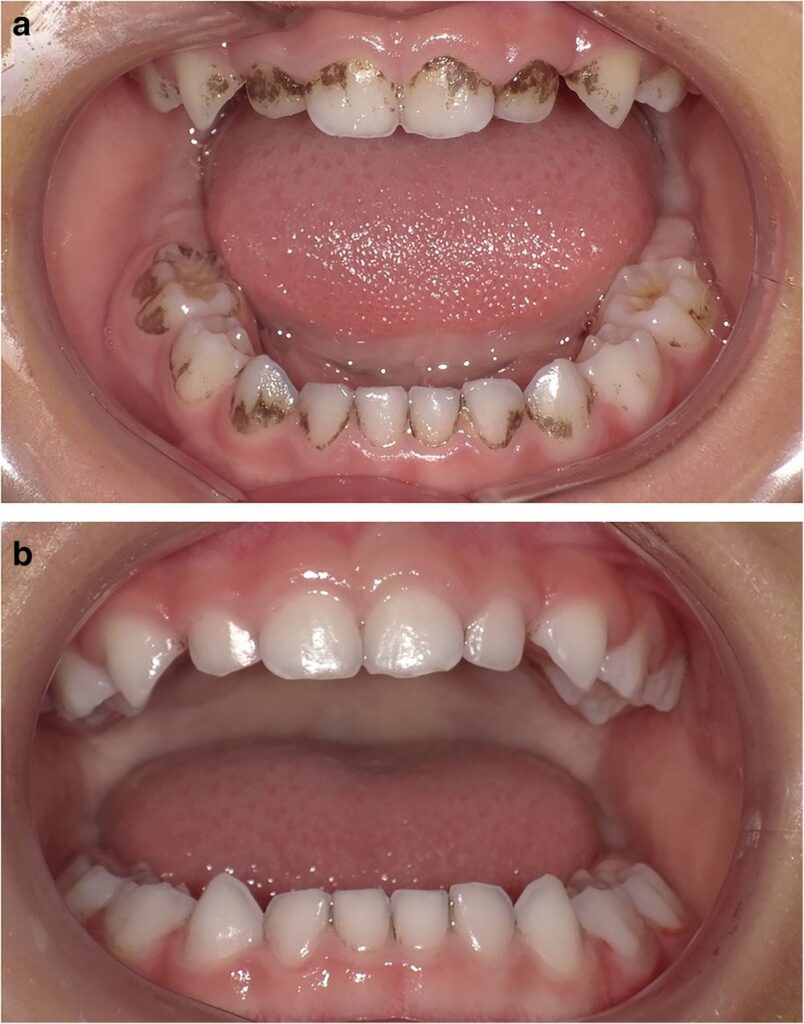
Many parents are concerned when they see small black dots forming a thin line along their child's gumline, even if the child brushes regularly. This is usually a black stain: a form of extrinsic tooth discoloration, commonly seen in pre-pubescent children, on both primary and permanent teeth.
Identifying black stains
- Small black dots or continuous black lines at the cervical area of the tooth, running parallel to the gumline
- Commonly found on the outer and inner surfaces of teeth
- Firmly attached, cannot be removed by brushing
- Not a cavity: the tooth surface remains hard and smooth
Cause: iron sulfide (FeS) precipitation
In the plaque of children with black stains, there are often many chromogenic bacteria. These bacteria produce hydrogen sulfide (H₂S) gas. When H₂S meets iron present in saliva and gingival fluid, they react to form iron sulfide (FeS), an insoluble black compound. This precipitate adheres to the tooth surface and forms a line along the gum margin (Sangermano et al., 2019; Alammari et al., 2024).
Related factors include high levels of iron in saliva (from food, iron supplements, or iron metabolism disorders) and the composition of oral bacteria. Bacteria can be transmitted between family members through shared toothbrushes, cups, or spoons, so authors advise against letting family toothbrushes stay damp and touch each other (Sangermano et al., 2019).
Are black stains harmful?
Black stains primarily affect aesthetics, making children self-conscious about smiling. Interestingly, children with black stains often have fewer cavities: a cohort study of 1,129 5-year-olds recorded black stains in 3.5% of children and associated them with a lower caries rate (França-Pinto et al., 2012). Black stains also tend to decrease as children pass puberty. However, the child should still be examined to distinguish them from cavities and to have them cleaned properly.
Why is regular scaling difficult to clean thoroughly?
Iron sulfide stains are very thin, firmly attached, and located close to the gumline and in small grooves on the enamel. Metal scaler tips struggle to reach all these areas without causing sensitivity or discomfort; many children are also afraid of the noise and vibration. Furthermore, any cleaning method only removes existing stains and does not prevent them from returning, which is very common if the underlying cause is not controlled (Sangermano et al., 2019).
Treatment at Lumière: air-water-powder cleaning combined with lactoferrin

Air-water-powder cleaning. With the Woodpecker PT-E machine, a stream of air, water, and fine powder enters small grooves and close to the gumline, removing black stains without the nozzle touching the teeth. The water is warmed, making the child more cooperative.
Lactoferrin. Lactoferrin is a natural protein found in milk and saliva that has the ability to bind with iron. When free iron levels decrease, it is harder for bacteria to form iron sulfide precipitates. Lactoferrin also affects the oral microbiome. Case reports show promising results in limiting the recurrence of black stains, although current evidence is limited (Sangermano et al., 2019). The dentist will prescribe the appropriate form and duration for each child; parents should not purchase it for their child to use on their own.
What should parents do at home?
- Have your child brush their teeth twice a day with fluoride toothpaste, using an amount appropriate for their age.
- Keep toothbrushes dry, do not let family members' toothbrushes touch each other, and replace them periodically.
- Do not attempt to scrape off black stains with hard objects.
- If your child is taking iron supplements as prescribed, do not stop without consultation; please discuss this with your pediatrician.
- Bring your child for regular check-ups and cleanings according to the appointment schedule.
Frequently Asked Questions
Are black stains caused by the child not brushing their teeth well?
Not necessarily. Black stains are also found in children with good oral hygiene, as the primary causes are chromogenic bacteria and iron in the saliva. Proper brushing still helps to limit plaque in general.
Are black stains contagious?
The associated bacteria can be transmitted between family members through shared toothbrushes, cups, or spoons. Each person should have their own toothbrush, kept dry and separate.
How long after cleaning do the black stains return?
It depends on the child. Black stains tend to recur, so the dentist will schedule follow-up visits and may prescribe lactoferrin to help minimize recurrence.
Is air-water-powder cleaning safe for primary teeth?
Yes. The dentist selects a fine, low-abrasion powder and adjusts the pressure to be suitable for your child's primary teeth and gums.
Does your child have black spots on their teeth? Book an appointment for a professional examination and advice on appropriate cleaning methods.
References
- Sangermano, R., Pernarella, S., Straker, M., Lepanto, M. S., Rosa, L., Cutone, A., Valenti, P., & Ottolenghi, L. (2019). The treatment of black stain associated with of iron metabolism disorders with lactoferrin: A literature search and two case studies. La Clinica Terapeutica, 170(5), e373–e381. https://doi.org/10.7417/CT.2019.2163
- Chen, L., Zhang, Q., Wang, Y., Zhang, K., & Zou, J. (2019). Comparing dental plaque microbiome diversity of extrinsic black stain in the primary dentition using Illumina MiSeq sequencing technique. BMC Oral Health, 19, 269. https://doi.org/10.1186/s12903-019-0960-9
- Alammari, S. T., Al Rubaie, F. M., & Shukr, B. S. (2024). Chromogenic black dental staining in children: A case report. Cureus, 16(1), e51984. https://doi.org/10.7759/cureus.51984
- França-Pinto, C. C., Cenci, M. S., Correa, M. B., Romano, A. R., Peres, M. A., Peres, K. G., Matijasevich, A., Santos, I. S., Barros, A. J. D., & Demarco, F. F. (2012). Association between black stains and dental caries in primary teeth: Findings from a Brazilian population-based birth cohort. Caries Research, 46(2), 170–176. https://doi.org/10.1159/000337280
- Inchingolo, F., Inchingolo, A. M., Latini, G., Pezzolla, C., Trilli, I., Sardano, R., Palermo, A., Inchingolo, A. D., & Dipalma, G. (2025). Analysis of microbiota in black stain of children and its impact on caries risk. A systematic review. European Journal of Paediatric Dentistry, 26(3), 192–200. https://doi.org/10.23804/ejpd.2024.2191
Treatment results depend on each individual's oral health and general health. The dentist will advise on a suitable treatment plan after examination.