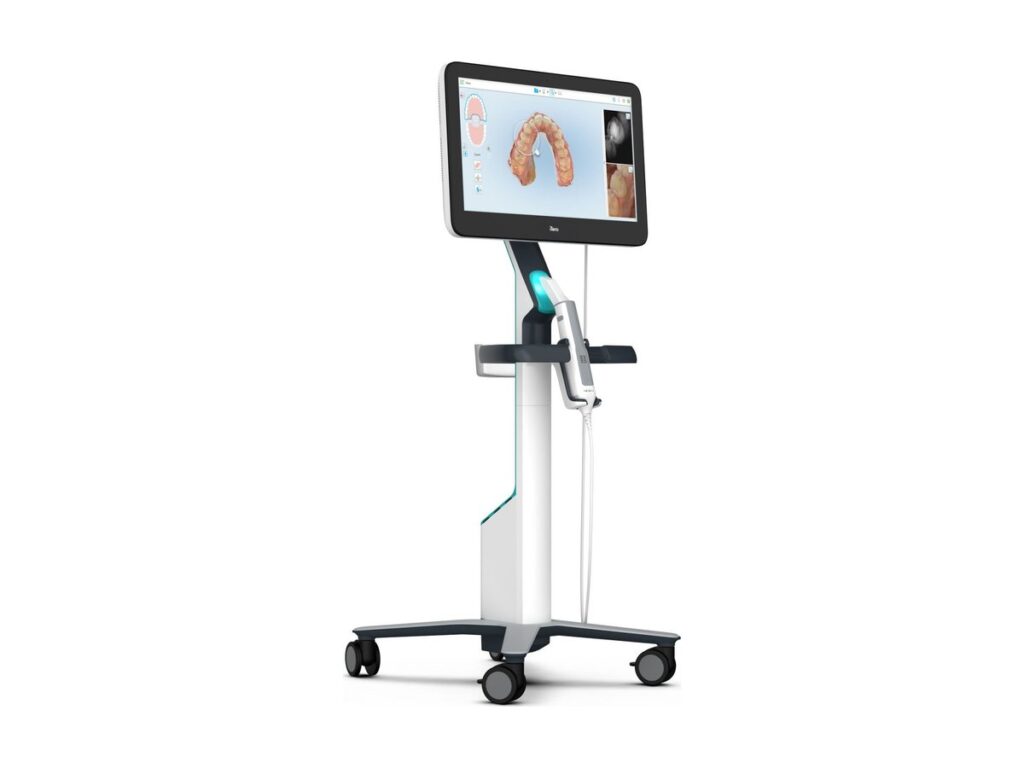
Caries in the interproximal space, which is the contact surface between two teeth, are often difficult to see with the naked eye. Previously, dentists mainly relied on bitewing X-rays for detection. The iTero Element 5D scanner at Lumière adds another method: in a single scan, the device records 3D images, intraoral color photos, and near-infrared (NIRI) images to help detect and monitor interproximal caries without using X-rays.
What is NIRI?
NIRI (Near-Infrared Imaging) is a technique that captures images using near-infrared light with a wavelength of 850 nm. Healthy enamel and areas of enamel demineralized by decay scatter this light differently, so on NIRI images, the lesion appears distinct from the surrounding enamel. This allows the dentist to identify lesions in the interproximal space, above the gum line, from the early enamel stage.
This is non-ionizing light, not X-ray radiation, so it can be used at every routine check-up to compare over time.
Effectiveness has been studied
A multicenter prospective study on 100 patients at 5 clinics, examining 3,499 posterior interproximal surfaces using the iTero Element 5D, recorded that the accuracy of NIRI was 88% for early enamel lesions and 97% for lesions that had reached the dentino-enamel junction. NIRI is more sensitive than bitewing films in detecting early enamel lesions and equivalent to bitewing films for lesions that have reached the dentin (Metzger et al., 2022).
Early detection while the lesion is still in the enamel gives the dentist more options: monitoring, remineralization, or minimally invasive intervention instead of having to perform large fillings later.
Does NIRI completely replace X-rays?
No. NIRI observes the tooth area above the gum line. When it is necessary to evaluate the tooth roots, alveolar bone, subgingival lesions, or plan implants, the dentist will still prescribe X-rays or CT scans. NIRI helps limit the number of unnecessary X-rays, especially in children and people who need frequent caries monitoring.
One scan, a wealth of information
- 3D dental impressions without impression trays, no material odors, and less likely to cause gagging
- Intraoral color photos for you and your dentist to view directly on the screen
- NIRI images to support the detection and monitoring of interproximal caries
- Compare scans over time to see tooth wear, gum recession, or tooth movement
- 3D data used for porcelain teeth, porcelain veneers, implants, and clear aligner orthodontics
Who should have an iTero 5D scan?
- Patients having routine dental check-ups who want to check for interproximal caries while minimizing X-ray exposure
- Children and adolescents who need to monitor for tooth decay
- Patients preparing for dental crowns, veneers, implants, or orthodontics
Want to know if this technology is right for you? Book an appointment or see more about Technology & Sterilization at Lumière.
References
- Metzger, Z., Colson, D. G., Bown, P., Weihard, T., Baresel, I., & Nolting, T. (2022). Reflected near-infrared light versus bite-wing radiography for the detection of proximal caries: A multicenter prospective clinical study conducted in private practices. Journal of Dentistry, 116, 103861. https://doi.org/10.1016/j.jdent.2021.103861
Treatment results depend on each individual's oral health and general health. The dentist will advise on a suitable treatment plan after examination.