
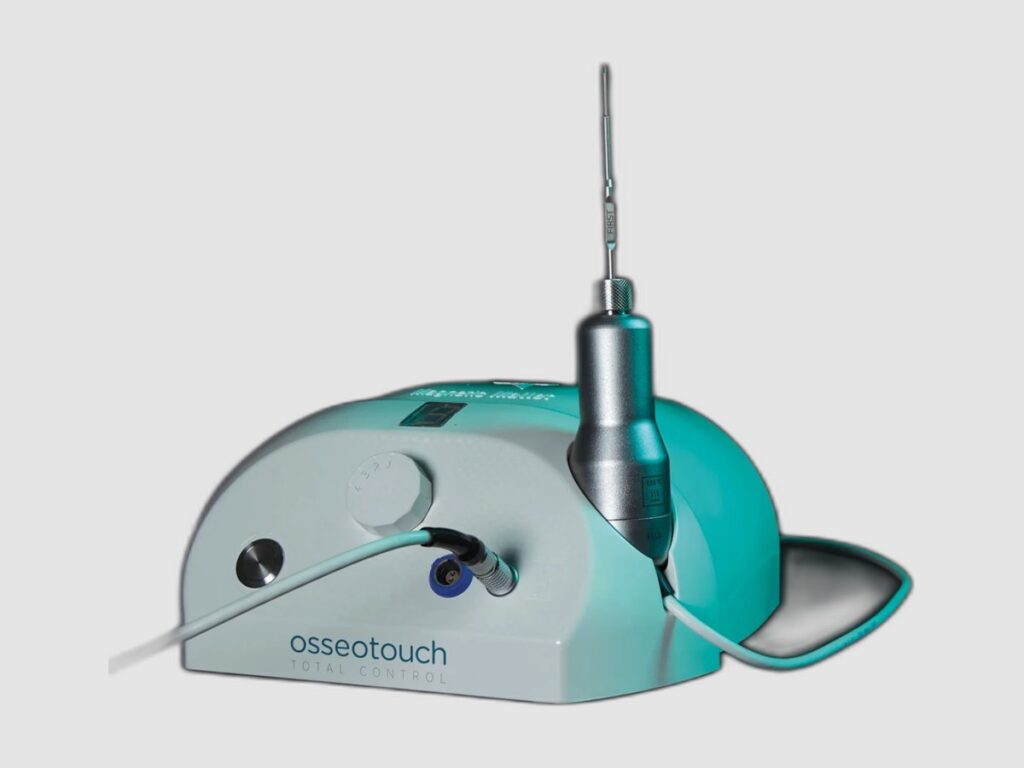
What makes many people anxious about getting an implant is the sound of the drill. In the traditional technique, the implant site is created using a series of drills with increasing diameters, and each drill removes a portion of the bone. The Magnetic Mallet by Osseotouch (Italy) prepares the implant site differently: it uses magneto-dynamic technology instead of a rotating drill.
How does the device work?
The handpiece emits very short, controlled magnetic pulses transmitted to the osteotome tip. The osteotome moves straight along the axis, expanding and compacting the surrounding bone instead of cutting it away. The implant site is created using osteotomes with increasing diameters. Without a rotating drill, you will only feel gentle tapping sensations, with no screeching drilling noise.
Advantages compared to traditional drilling
- Bone preservation. Bone is compacted and expanded rather than drilled away, which is especially beneficial in areas of porous, low-density bone such as the posterior maxilla.
- Higher primary implant stability. Studies on low-density bone models have noted that magneto-dynamic preparation provides higher primary stability for implants compared to conventional drilling (Antonelli et al., 2023; Sheikh Ibrahim & Jaafo, 2024).
- Expansion of narrow alveolar ridges. In a series of clinical cases, the thickness of the maxillary ridge increased on average from approximately 4.4 mm to 7.0 mm after 3 months when combining bone expansion with implant placement (Baldi et al., 2025).
- Minimally invasive sinus lift. It is possible to lift the sinus floor via the crestal approach in certain cases.
- No heat from friction. There is no rotating drill creating friction with the bone.
- More comfortable than a manual mallet. Compared to tapping an osteotome with a manual mallet, magnetic pulses are shorter and more uniform; one study noted 2 cases of post-operative positional vertigo in the manual mallet group, with none in the magneto-dynamic group (Crespi et al., 2013).
- Suitable for those who fear the sound of drills.
Is it suitable for everyone?
This method is highly suitable for low to medium-density bone. In very dense bone, the dentist may still need a drill for certain steps. Before treatment, the dentist will evaluate the bone quality and thickness on a CT scan to let you know if it can be applied to your case. The technique also requires a dentist who is trained and experienced.
Want to know if this technology is right for you? Book an appointment or see more about Technology & Sterilization at Lumière.
References
- Antonelli, A., Barone, S., Attanasio, F., Salviati, M., Cerra, M. G., Calabria, E., Bennardo, F., & Giudice, A. (2023). Effect of implant macro-design and magnetodynamic surgical preparation on primary implant stability: An in vitro investigation. Dentistry Journal, 11(10), 227. https://doi.org/10.3390/dj11100227
- Sheikh Ibrahim, A., & Jaafo, M. H. (2024). A comparison of different implant site preparation techniques in low-density bone: An ex-vivo study. Cureus, 16(9), e70318. https://doi.org/10.7759/cureus.70318
- Baldi, D., Colombo, J., Cassinotto, E., Bagnasco, F., De Giorgis, L., Baldi, F., Morawiec, T., Pesce, P., & Menini, M. (2025). Evaluation of the crestal bone expansion obtained with the Magnetic Mallet® during the preparation of the implant site: A case series. Minerva Dental and Oral Science, 74(5), 318–327. https://doi.org/10.23736/S2724-6329.25.05106-X
- Crespi, R., Capparè, P., & Gherlone, E. (2013). Electrical mallet provides essential advantages in maxillary bone condensing. A prospective clinical study. Clinical Implant Dentistry and Related Research, 15(6), 874–882. https://doi.org/10.1111/j.1708-8208.2011.00432.x
Treatment results depend on each individual's oral health and general health. The dentist will advise on a suitable treatment plan after examination.